
Office · Informational
Scope Creep in Cleaning Contracts and How to Prevent It
Scope creep quietly erodes cleaning quality and goodwill on both sides. Here is how it happens in Melbourne office contracts and how to prevent it fairly.
5 min read
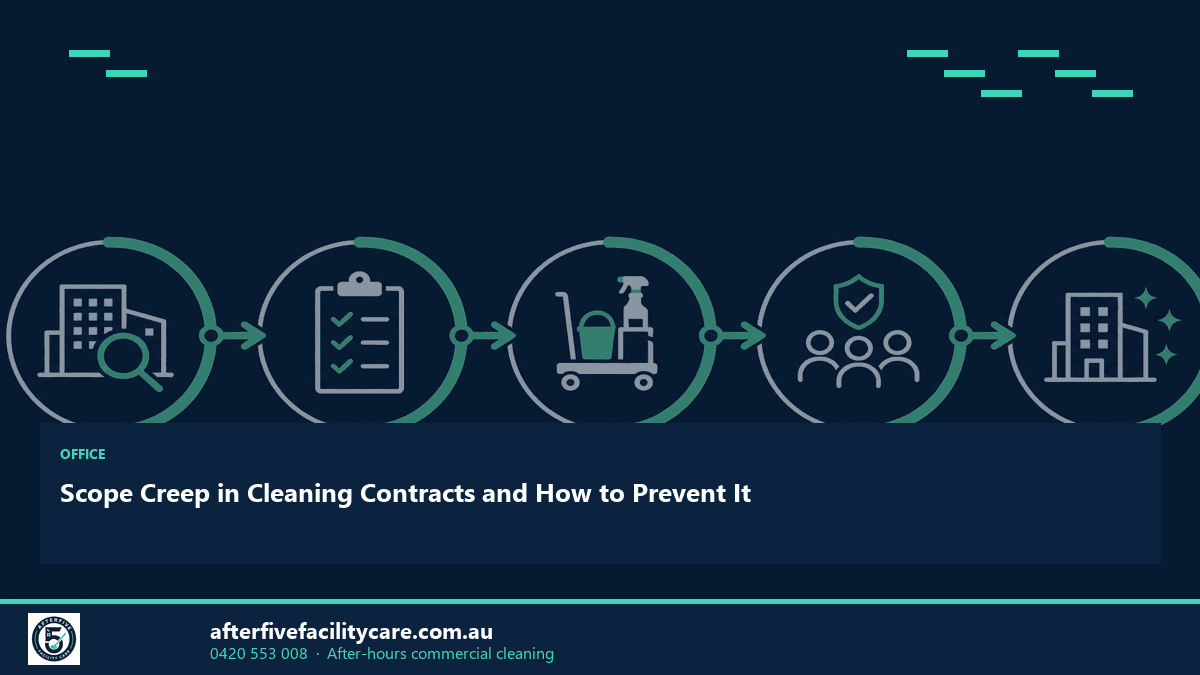
Most cleaning contracts do not fail suddenly. They erode. A small extra request here, a quietly dropped task there, and eighteen months later the work being done bears little resemblance to what was agreed — usually with resentment on both sides. This is scope creep, and it is one of the most common reasons office cleaning relationships sour. The decision for a facility manager is not whether scope creep will pressure the contract, but whether you have a system to manage it fairly before it damages either quality or goodwill.
What scope creep actually looks like
Scope creep is the gradual drift between what was agreed and what is expected, without a matching change to the contract or the price. It rarely arrives as a single big demand. It accumulates through small, reasonable-sounding moments:
- "While you're here, could you also do the storeroom?"
- "We've added a floor since we signed — same price, right?"
- An extra kitchen appears after a fit-out and is simply assumed to be covered.
- A one-off event clean-up quietly becomes a weekly expectation.
Each request is minor on its own. The problem is cumulative: the crew is doing more for the same money, quality on the core scope suffers as time stretches, and eventually something gives. Because it happens slowly, nobody notices until the relationship is already strained.
Scope creep runs in both directions
It is tempting to frame scope creep as clients asking for too much, but it works both ways, and an honest view acknowledges both.
| Client-driven creep | Provider-driven creep |
|---|---|
| Informal extra rooms or tasks | Quietly reduced cleaning frequency |
| Added floors or areas without a price change | Amenities dropped from the routine |
| One-off requests becoming standing expectations | Standards allowed to slip on detail tasks |
| "While you're here" additions | Shorter time on site than agreed |
Recognising both directions matters, because the solution is the same for each: a clear scope and a fair process protect the client from declining service and protect the provider from unpaid expansion. Scope creep is not a blame issue; it is a systems issue.
The written scope is your baseline
You cannot detect drift without a fixed reference point, and that reference is the written scope of works. When every task, zone, frequency, and exclusion is written down, any change becomes visible — because it is a change from something specific rather than a shift in a vague understanding.
This is exactly why exclusions matter so much. A scope that clearly states what is not included makes it obvious when a new request falls outside the agreement, which turns "while you're here" from an awkward grey area into a simple, answerable question: is this in scope, or is it a change? For offices across South-East Melbourne that grow, refit, or reconfigure regularly, a clear baseline is the difference between managed growth and silent erosion.
A simple change process
The goal is not to refuse every extra request — genuine needs change and should be accommodated. The goal is to route changes through a light, fair process instead of absorbing them informally. A workable process has three steps:
- Capture the request. New tasks or areas are noted rather than added on the spot.
- Price and agree the change. The provider quotes the additional work, and both parties agree before it becomes standing.
- Update the scope. The written scope is amended so the new expectation is formal and the price reflects reality.
This protects everyone. The client gets the extra work done properly rather than squeezed into an already-full visit; the provider is paid for what they deliver; and the core scope does not quietly degrade to make room for uncosted additions. A five-minute process at the point of request prevents months of accumulated friction.
Regular reviews catch drift early
Even with a good scope and change process, offices change faster than contracts do. A periodic review — quarterly or at least twice a year — keeps the contract aligned with reality. A review is simply a conversation against the written scope: Has the headcount grown? Has the floor plan changed? Are the busy days different under hybrid work? Are any tasks consistently being missed or consistently being added?
These reviews are where drift gets corrected before it becomes a grievance. They also build the trust that keeps a cleaning relationship stable for years, because both parties know there is a regular, fair forum to raise concerns rather than letting them fester. Under hybrid work in particular, occupancy patterns shift often enough that a scope set two years ago is rarely still the right one today.
Communication prevents most of it
Underneath the process, most scope creep is prevented by simple, open communication. When a facility manager and a cleaning provider talk regularly, genuine needs are raised and added formally, small issues are fixed before they escalate, and neither side feels taken advantage of. When communication is poor, requests go underground — asked informally, absorbed quietly, and resented on both sides.
The healthiest cleaning relationships treat the scope as a living agreement, not a document filed and forgotten. They add work formally, adjust the price fairly, review regularly, and talk when something changes. That approach costs nothing and prevents the slow decline that ends most contracts.
Keeping the contract healthy
Scope creep is entirely preventable, and none of the prevention is complicated: start with a clear written scope including exclusions, route changes through a light process, review the contract periodically, and keep communication open. Do those four things and the contract stays honest — the client keeps getting the service they pay for, and the provider keeps being paid for the service they deliver.
If your current cleaning arrangement has drifted from whatever was originally agreed, the fix starts with getting a clear, written scope back in place. AfterFive builds a written after-hours office cleaning scope after a walkthrough, so you have a firm baseline to work from, and you can book that visit here to reset the contract on solid ground.
FAQs
What is scope creep in a cleaning contract?
Scope creep is the gradual expansion of expected work beyond the agreed scope without a matching change to the contract or price. It usually happens through small, informal requests that accumulate over time.
How do I prevent cleaning scope creep?
Start with a clear written scope, route new requests through a simple change process, review the contract periodically, and keep communication open so genuine needs are added formally rather than absorbed informally.
Is scope creep always the client's fault?
No. It happens from both directions — clients ask for extras informally, and providers quietly reduce frequency or standards. A clear scope and regular reviews protect both parties equally.